What Founders Should Stop Coding Themselves (and Delegate to a Software VA)
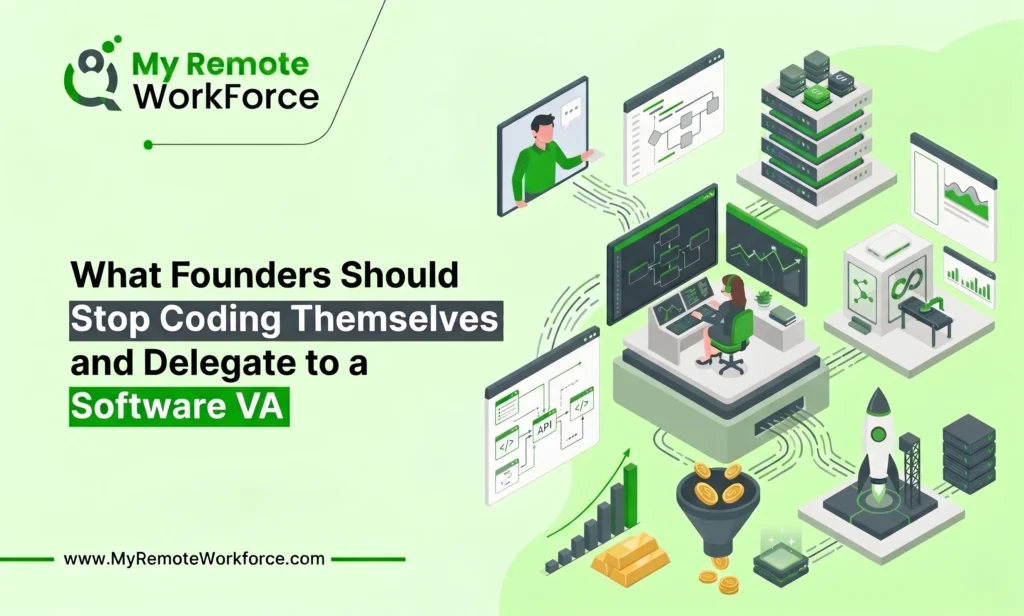
The modern founder operates at the intersection of vision and execution. Yet too often, founders spend a disproportionate slice of their day on repetitive technical tasks, code that could be automated, bugs to triage, and tiny website tweaks—tasks that steal time from growth, fundraising, and product refinement.
A Software VA—a specialized remote technical assistant within a managed, distributed workforce—can take those tasks off the table, freeing leadership to drive strategy, customer acquisition, and scale. This approach isn’t about outsourcing core IP; it’s about removing bottlenecks so the business can accelerate.
Why Founders Become Operational Bottlenecks
Founders are inherently cross-functional, but that breadth can become a crisis of focus. When you own the majority of technical execution, you’re forced to choose between shipping features and maintaining stability, or between fundraising calls and debugging a tricky API. This is a structural bottleneck.
A growing body of thought on founder burnout underscores this exact risk: when daily operations absorb your energy and attention, crucial strategic moves like hiring, fundraising, and setting a compelling product vision slide to the back burner. For many, the consequence is not immediate collapse but a gradual drift: slower growth, delayed milestones, and missed opportunities. Recent business commentary heavily highlights the risks of occupying too many operational lanes.
The practical implication is clear: leadership time must be freed up for high-leverage work only a founder can do, while routine technical tasks are handled by capable specialists.
The Hidden Cost of Low-Impact Coding
Time is money, especially for early-stage ventures. When founders spend hours on routine bug fixes, minor integrations, or quick website edits, those hours yield a low ROI. Emerging data on virtual assistants and remote talent show a tangible payoff: when specialists handle repetitive technical tasks, overall operating efficiency improves, and the leadership team regains meaningful capacity.
The 2026 ROI Math: Industry insights point to measurable benefits. VA usage data from 2026 indicates that virtual assistants, especially those with specialized software know-how, can improve workforce efficiency by up to 35% and save an average of 22 minutes per day on routine activities.
This kind of time savings compounds quickly at the leadership level, translating into more cycles for product validation, GTM experiments, and strategic partnerships. By framing technical work as a delegated function, founders can reallocate precious time toward growth levers rather than maintenance chores.
Signs It’s Time to Delegate Technical Work
Delegation is not a binary decision; it’s a spectrum informed by workload, risk, and strategic priorities. You have likely reached a critical delegation inflection point if:
🎯 You’re consistently missing growth or fundraising milestones because you’re tied to bug fixes or minor integrations.
🔁 Repetitive technical tasks occur so frequently that they become predictable but not strategic.
🐢 Your engineering velocity slows as you juggle maintenance, deployments, and dashboards rather than high-leverage product work.
😰 You’re losing sleep over operational reliability and security concerns that someone else could own without sacrificing vision.
⏳ Your onboarding for new initiatives becomes an afterthought because you’re busy patching old issues.
A practical takeaway: Use these signals as a trigger to pilot a Software VA for a defined set of tasks (for example, handling Shopify/E-commerce support, minor CRM automations, or routine QA testing). Not every task will be a fit for delegation, but the right subset will unlock headroom for product strategy and customer acquisition.
The Technical Delegation Blueprint
Tasks Founders Should Stop Coding Themselves
Founders should immediately deprioritize hands-on work that is repetitive, low-risk, and high-frequency. This includes:
Bug fixes and maintenance updates
Shopify and e-commerce technical support
Website updates and landing page edits
CRM integrations and automation tasks
QA testing and troubleshooting
API monitoring and simple backend tasks
Data entry and technical admin work
Plugin updates and CMS management
Documentation and SOP creation
Reporting dashboards and analytics setup
Freeing yourself from these activities creates space for strategic decisions, customer conversations, and fundraising outreach while drastically reducing productivity-draining context-switching.
What a Software VA Can Realistically Handle
A Software VA operates as an extension of your distributed team, focused on high-frequency, high-value support tasks. Provided they have access to the right tools and governance, a capable Software VA can handle end-to-end tasks across your stack:
Workflows & Maintenance: Routine maintenance tasks, data workflows, testing, and system monitoring.
Light Development: Implementing small, well-scoped automations and integrations.
Specialized Platforms: Managing CRMs, e-commerce suites, marketing dashboards, and lightweight back-end tasks with minimal handholding.
This specialization reflects a broader 2026 trend toward remote, talent-based scalability that successfully combines cost efficiency with operational continuity.
Best Practices for Onboarding and Management
Onboarding a Software VA is not a one-off handoff; it’s a process that builds lasting operational clarity and trust.
Establish a Baseline: Start with an explicit scope, clear success criteria, and shared documentation.
Project Management: Use a lightweight project-management layer to assign tasks, track progress, and escalate issues.
Communication Rhythms: For distributed teams, set regular synchronous and asynchronous check-ins.
Governance Protocols: Define strict access controls for systems, create runbooks for common scenarios, and implement a simple change management protocol so the VA can safely execute changes within defined boundaries.
Choosing the Right Partner
For startups, choosing the right partner is critical. My Remote Workforce (MRWF) positions itself as a managed remote workforce provider, offering a vetted, distributed team that integrates seamlessly with your existing tech stacks and processes.
This approach helps preserve product velocity while ensuring consistent quality and security across remote engagements. The value proposition for founders is straightforward: you gain predictable delivery, access to specialized technical talent, and the continuity of a managed team rather than a loose network of freelancers.
Key Takeaways
Break the Bottleneck: Reallocating routine technical work to a Software VA unlocks strategic time for core growth levers and fundraising.
Compounding Efficiency: Software-VA-driven delegation yields up to a 35% increase in workforce efficiency, giving founders their days back.
Identify the Triggers: Watch for signs like missed milestones or slowed engineering velocity to know exactly when to pilot a VA.
Structure the Hand-off: Utilizing a clear blueprint of what to delegate and what a VA can handle ensures predictable, low-risk outcomes.
Prioritize Governance: Sustainable remote collaboration requires secure onboarding, clear SLAs, and well-defined runbooks.
Conclusion: Stop Working In Your Code, Start Working On Your Business
As a founder, your primary code language should be the strategy that scales your company—not the minor patches holding it together. Continuing to handle repetitive, low-impact technical chores isn’t just a drain on your energy; it is an expensive misallocation of leadership equity that actively delays your next milestone.
By offloading execution to a trusted, specialized Software VA, you systematically decouple your growth potential from your personal daily bandwidth. You protect your time, prevent burnout, and position your startup to move at the speed the market demands.
Visit My Remote Workforce today to explore how a managed, vetted remote technical support model can be custom-tailored to your stack, giving you the freedom to lead while your product keeps humming.