
Why Every Growing Shopify Store Needs a Software Virtual Assistant
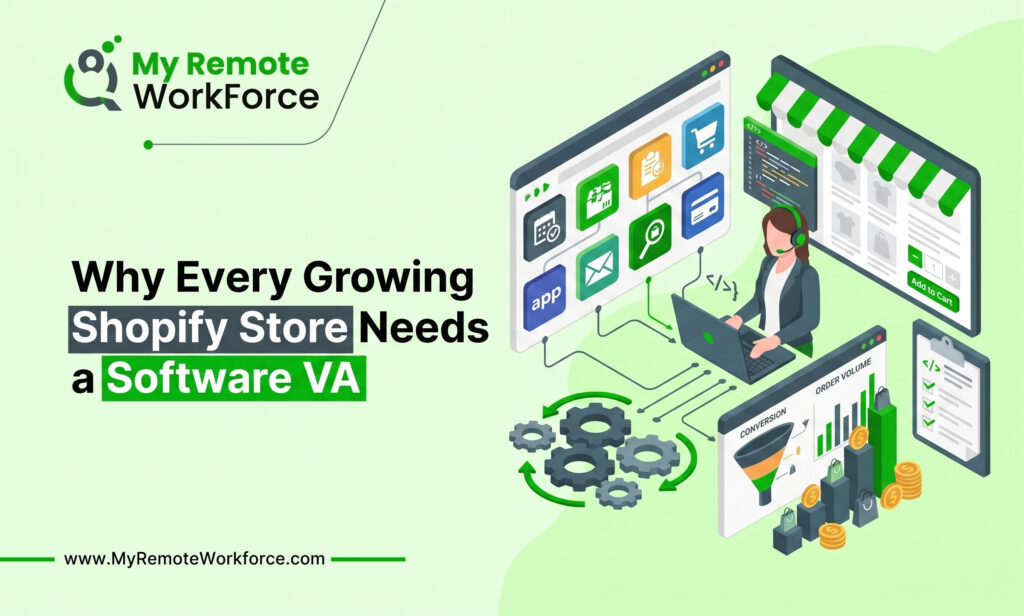
Shopify now powers over 4.8 million active stores globally and captures roughly 26.2% of all ecommerce websites. As brands push to scale, founders confront a persistent bottleneck: time. In this blog, we explore how a Software VA for Shopify can unlock scalable operations without adding unnecessary overhead, helping ecommerce businesses grow with discipline and control.
In the era of agentic commerce, the idea that a platform can automate complex tasks with native AI and connected tools, Shopify is evolving beyond a storefront builder. Enterprise AI capabilities on Shopify are becoming accessible to merchants of all sizes, driving faster experimentation and smarter automation. This shift underscores why a specialized approach to remote talent, such as a Software VA, matters for growth.
What is a Software VA for Shopify?
A Software VA (virtual assistant) is not a generic admin helper or a freelance coder. It is a purpose-built, remote professional who blends process design, platform fluency, and automation mindset to operate your Shopify stack with SOP-driven discipline. Unlike a traditional VA who may handle scattered tasks, a Software VA is trained to work within a defined operating system, Shopify backend, related apps, and data flows, so the storefront moves smoothly without founders becoming the backlog owner. A Shopify developer virtual assistant combines development-ready skills with VA-like governance, nudging code changes while preserving the SOPs and SLAs that keep the store running smoothly. For growing brands, the distinction matters because a Software VA delivers reproducible, low-friction outcomes without the risk of bespoke, one-off fixes that bottleneck momentum.
Expert commentary: In growing e-commerce, the value of a Software VA rests on repeatability. When a task has a defined SOP, a Software VA can execute it consistently, report outcomes, and hand off to the next workflow without requiring the founder’s strategic input each time. This is how you convert bandwidth into momentum, not just task-shifting.
Growth Challenges and How Software VAs Address Them
Growing a Shopify store creates a suite of recurring pain points. A Software VA is designed to reduce these frictions by owning the operational backbone so you can scale with confidence.
1. Store Maintenance, App Integrations, and Theme Updates
As you add products, run promotions, and experiment with new apps, keeping the store reliable becomes a full-time job. A Software VA maintains product data accuracy, monitors inventory handoffs to 3PLs, and ensures that theme updates or app changes don’t disrupt customer experience. The right Software VA can coordinate multi-app workflows, reconcile orders across channels, and ensure that customer-facing pages stay fast and accurate, minimizing the risk of broken links or mismatched SKUs. In practice, a well-trained Shopify VA understands the core operating stack: Shopify backend, payment and shipping apps, and customer-facing tools, and can execute updates without escalating to a developer for every minor change. Shopify VA Playbook. This level of fluency is what makes a Software VA more cost-effective at scale than a sporadically engaged freelancer.
2. Automation, Data Reporting, and Performance Monitoring
Growth hinges on data-driven decision-making and repeatable automation. A Software VA can implement SOPs for daily reconciliations, create automated reports on key metrics (conversion rate, AOV, return rate), and run baseline experiments to test improvements in checkout or product pages. The virtual assistant serves as the regional chief of operations for your storefront stack, translating data into action and ensuring experimentation becomes a living, repeatable process rather than a one-off sprint. Market analyses from ecommerce-focused research highlight that VAs are maturing from cost centers to core, scalable workforce components of growth strategy.
3. Conversion Optimization and Customer Experience
Speed, accuracy, and consistency in responses drive buyer trust. A Software VA keeps support queues lean by routing inquiries through the appropriate automation paths, personalizing responses where appropriate, and promoting a smooth post-purchase experience (fulfillment updates, refunds, reviews). This not only preserves brand experience but reduces time-to-resolution, which correlates with higher customer satisfaction and retention. The broader industry context shows that the VA workforce is consolidating as a durable solution, with organizations reporting meaningful cost savings alongside scalable capacity. Virtual assistant industry insights.
4. Technical Troubleshooting and Onboarding
When a store encounters integration hiccups or API changes, a Software VA can triage, document, and escalate issues with well-defined playbooks. This avoids the founder spinning wheels on troubleshooting tickets and ensures continuity in product launches or promotions. Modern ecommerce platforms increasingly rely on agent-based automation, which makes expert, repeatable workflows essential for reliability. A dedicated Software VA becomes the go-to resource for day-to-day operational continuity, especially during high-velocity growth periods.
Useful context: the Shopify ecosystem is expanding, with hundreds of apps and integrations in play. The goal is not to replace developers but to create a scalable, maintainable operations layer that can respond quickly to growth signals while keeping the storefront healthy. E-commerce growth insights. For brands that aim to reach seven figures, this distinction is critical: you want a reliable operator who can sustain growth without doubling headcount or escalating costs.
Real-world Value Scenarios
To illustrate how Software VAs unlock value, consider three scenarios commonly faced by growing Shopify brands.
Scenario A: Launching a new feature with confidence: A brand wants to test a new checkout flow enhancement. A Software VA defines the task list, coordinates required apps, updates the theme code in accordance with approved SOPs, and monitors outcomes. The result is faster time-to-market with controlled risk, not a “wing it” approach.
Scenario B: Multichannel order orchestration and returns logic: As a store expands to social storefronts and marketplaces, a Software VA maintains parity across orders, updates inventory in real time, and handles post-purchase experiences (returns, refunds) with consistent customer messaging. Operational friction is minimized because a single operator governs shared processes rather than multiple contractors.
Scenario C: Data-driven optimization: A store aims to improve conversion by optimizing product detail pages and checkout flows. The Software VA partners with marketing processes to implement and analyze A/B tests, produce concise performance reports, and suggest SOP-driven adjustments for the next iteration. In practice, this leads to measurably faster iteration cycles and a better understanding of what moves buyers to purchase Shopify VA practices.
Thoughtful expert input: the superiority of a Software VA in these scenarios stems from the blend of defined SOPs, reliable automation, and domain-specific Shopify knowledge. When a task is structured and repeatable, the Software VA can own it end-to-end, delivering consistency at scale, an essential factor when growth compounds over quarters.
When to Hire a Software VA: Actionable Tips
Deciding when to bring in a Software VA hinges on workload patterns and strategic priorities. If you find that owners or operators are mired in daily operational tasks, or if growth initiatives stall due to bottlenecks in store maintenance, integrations, or reporting, it’s a strong signal to consider a dedicated Software VA. From a cost perspective, a Software VA can deliver significant savings by replacing ad-hoc contractor hours and reducing downtime during launches or promotions. Benefits and costs of hiring a Shopify VA. Start with a clearly defined SOP set and a measurable pilot scope (e.g., two to four weeks) to validate the impact on speed, reliability, and revenue metrics.
If you operate with multi-channel sales, plan to onboard a Software VA when you anticipate increased complexity in inventory, orders, and customer communication. The ROI becomes clearer as you offload routine but critical tasks that typically slow growth to a well-trained VA who can perform them consistently. Finally, when you want to preserve founder bandwidth for product development, brand partnerships, and strategic experiments, a Software VA is the pragmatic enabler of sustainable scale.
Key Takeaways
A Software VA for Shopify is a specialized remote operator who combines process discipline, platform fluency, and automation to run the storefront’s non-strategic work at scale.
Growth challenges, such as store maintenance, app integrations, theme updates, automation, and troubleshooting, are precisely where a Software VA adds measurable value by ensuring reliability and speed.
Real-world scenarios show how VAs accelerate launches, optimize checkout flows, and coordinate multi-app ecosystems without bloating overhead.
My Remote Workforce offers a managed remote workforce specifically designed to support Shopify’s growth with vetted Software VAs, governance, and onboarding that align with distributed teams.
Conclusion
Growth without burnout is possible when you replace founder-era bottlenecks with a scalable operating model built around a Software VA for Shopify. By offloading routine yet critical tasks from maintenance and integrations to automation and reporting, you unlock bandwidth for strategic initiatives that move the business forward.
My Remote Workforce positions itself as a managed remote workforce provider, not a freelance marketplace. The distinction matters: our model emphasizes vetted, performance-driven talent, formal onboarding, clear governance, and alignment with your existing teams. For Shopify stores, MRWF provides Software VAs who are specifically trained to work within the Shopify ecosystem, with a focus on time-zone alignment, security, and scalable SOPs. This alignment reduces the risk of miscommunication and ensures continuity as you scale. The broader market research reinforces that VAs are consolidating as a durable backbone for scalable operations, with cost savings and flexible capacity that complement in-house teams or agencies Global VA market outlook. By engaging MRWF, you gain a partner who understands distributed teams, nearshore/offshore dynamics, and the governance processes that keep a Shopify storefront running smoothly under growth pressure.
To explore how My Remote Workforce can help you scale with a Software VA for Shopify, talk to our expert now.



Stay Ahead with Smarter Business Tips
Subscribe for quick reads on getting more done (without doing it all yourself), delegation wins, productivity hacks, and VA tips that actually help.