How to Onboard a Software VA in 48 Hours
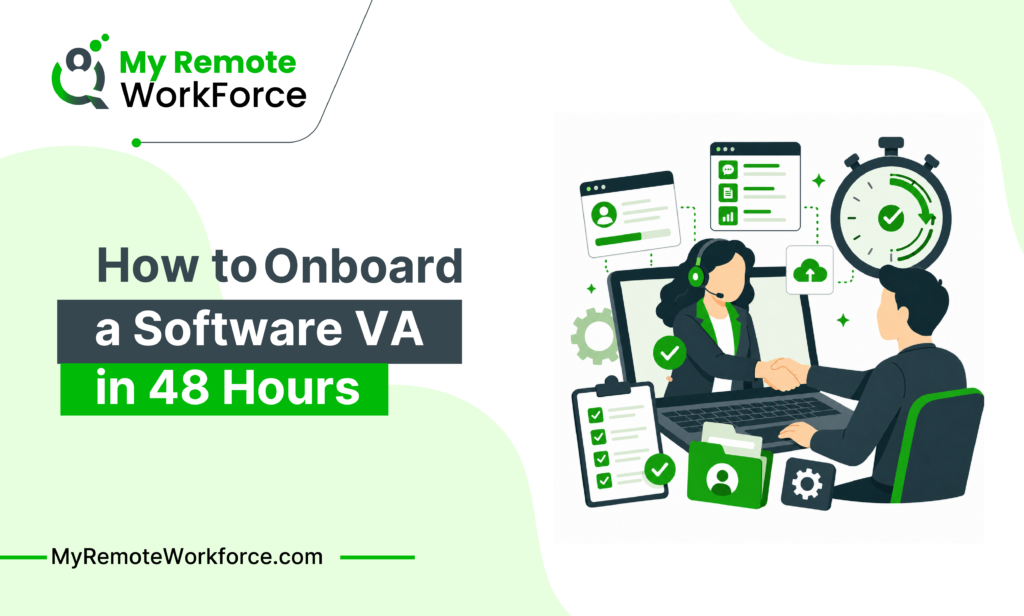
How To Onboard A Software VA In 48Hours
Traditional technical hiring takes an average of 40+ days, draining internal engineering bandwidth and stalling critical project sprints. For fast-growing SaaS, ecommerce, and software-powered businesses, scaling doesn’t always require a full-time hire—it requires immediate execution. By leveraging a Software Virtual Assistant (VA), teams can inject velocity into QA cycles, CRM workflows, and operational automation almost instantly.
However, the key to unlocking this speed is a resourceful, highly structured onboarding protocol. When armed with precise Standard Operating Procedures (SOPs), role-based access controls (RBAC), and a prioritized task backlog, a remote software assistant can bypass the typical weeks-long ramp-up and start producing within hours. In this guide, we bypass theory to deliver a practical, experience-tested playbook.
We will show you exactly how to architect a 48-hour onboarding window that minimizes security risks, establishes clear governance, and maximizes immediate ROI for your growing business.
Why Fast Onboarding Matters For Growing Businesses
Speed to value is a competitive advantage. When a Software VA enters a project with clear goals, documented workflows, and secure access, they can contribute to critical sprints, reduce cycle times, and unlock scale without the overhead of traditional hires. A rapid onboarding cadence minimizes the risk of misalignment, saves time on back-and-forth clarification, and accelerates early wins essential for proof-of-concept moments, customer-facing fixes, and automation initiatives.
For decision-makers, the math is simple: faster onboarding often translates to earlier feature delivery, fewer bottlenecks in release trains, and lower burn rate on non-core activities. For a robust, technically oriented role, a well-orchestrated two-day onboarding window is not a gimmick—it’s a disciplined process backed by governance, security, and documentation. Research and best practices from talent and HR disciplines emphasize onboarding as a strategic lever for productivity and retention, not a one-off formality (SHRM onboarding guidelines).
A Software VA is a defined role within the broader remote staffing ecosystem. They bring specialized capabilities—development support, quality assurance, automation, Shopify administration, CRM updates, and technical admin tasks—without requiring full-time, in-house headcount. This model supports distributed teams, time-zone alignment, and scalable workloads while delivering cost efficiency and operational continuity. To succeed, the onboarding plan must address trust, security, and clear task ownership from day one, ensuring that the VA’s contributions align with product goals and compliance requirements (NIST cybersecurity principles for access control and least privilege).
What A Software VA Can Handle And Where They Fit
A Software VA is a purpose-built, remote professional who can support both development-oriented work and operational tasks. They are not a substitute for full-stack engineers or product managers, but they can handle a broad spectrum of work that accelerates delivery and frees your core team to focus on core differentiation. Typical capabilities include:
Development support: Code reviews, bug triage, test automation scaffolding, and scripting for build pipelines.
QA and testing: Creating test cases, executing tests, logging defects, and supporting automation should the scope require it.
Shopify and ecommerce tasks: Product updates, order flow optimizations, app integrations, theme tweaks, and order/data hygiene.
CRM and data updates: Contact and account hygiene, workflow automation, data migration helpers, and record synchronization.
Automation and tooling: Lightweight automation scripts, nightly data pulls, dashboarding, and alerting.
Technical administration: Repository hygiene, access provisioning, and documentation maintenance.
Definitions help here: A Software VA is a remote contributor who specializes in software-related tasks but is not a replacement for a full-time development team. Remote staffing, when managed with clear SLAs, security controls, and well-defined SOPs, can scale with a growing business and provide predictable outcomes. The key is ensuring that the tasks are scoped, auditable, and measured against observable deliverables.
For example, a Shopify Software VA might own a recurring task, such as weekly product data imports and price rule updates, while a software development VA might own a micro-automation script that reduces repetitive admin work. In practice, many teams blend several capabilities across development support, QA, and automation to cover the most time-consuming operational gaps without bloating the core team.
Thoughtful question: Is a Software VA best used for pure coding, or for enabling velocity across development sprints? The answer: They excel at accelerating velocity by owning repeatable tasks, automation, and guardrails around release cycles, while your core engineers concentrate on architecture and core features. This balance delivers the fastest path to observable outcomes.
The 48 Hour Onboarding Playbook
A reliable 48-hour onboarding window rests on disciplined preparation, controlled access, and a collaborative kickoff. The following sequence keeps onboarding tight, focused, and auditable.
1. Preparation Before Day One
Prepare a one-page role brief that defines the VA’s responsibilities, expected deliverables, and overlaps with the existing team. Create a prioritized backlog of tasks that are safe to start immediately and clearly delineate dependencies on product or design teams. Assemble essential SOPs and workflows that the VA will rely on, including how to file bugs, request access to environments, and log work. Security begins here: identify required credentials, apply the principle of least privilege, and decide on temporary access controls and expiration dates.
2. Access And Security
Grant access using least privilege and time-bound credentials. Enforce strong authentication, such as single sign-on (SSO), and implement role-based access control (RBAC). Use a short-lived access window for sensitive systems and ensure there is an auditable trail of actions. A security-first onboarding plan reduces risk and provides reassurance to leadership and engineers alike.
3. Tools, Permissions, and Environments
Confirm the project management and communication framework early. If you use a shared workspace (for example, a Jira/Confluence pair and a Slack/Teams channel), ensure the VA is enrolled with appropriate notifications and that ownership of dashboards or pipelines is explicit. Provide a sandboxed environment where the VA can experiment without impacting production, and document how to request production changes to minimize risk.
4. SOPs, Workflows, and Documentation
Share the most critical SOPs first: how to report incidents, how to commit changes, how to deploy a small feature, and how to test before pushing. The documentation should be actionable, not rhetorical, with concrete steps, inputs, and outputs. If your SOPs are still evolving, include a change log and a clear update path so the VA can adapt quickly without rework.
5. The Quick Kick-Off Meeting
Schedule a compact kickoff (30–45 minutes) with your VA, the team lead, and the immediate stakeholders. The agenda should cover: objectives for the first two weeks, the most urgent tasks, acceptance criteria for deliverables, and communication conventions (response times, stand-ups, and escalation paths). Ensure there is a shared understanding of what “done” looks like so the first deliverable can be reviewed quickly and accurately. For a remote technical talent, a concise kickoff reduces ambiguity and sets expectations for remote collaboration.
6. First Week Task Blueprint
Assign 2–3 high-impact tasks with clear acceptance criteria and deadlines. Examples include: setting up a Shopify product import automation that runs on a defined schedule, implementing a lightweight QA smoke test for a new feature, and updating CRM workflows to reflect a new stage in the customer lifecycle. As a practical rule, prioritize tasks that produce measurable, visible outcomes within the first week to establish momentum.
Expert commentary: In practice, speed must be paired with quality. A high-velocity onboarding plan should include bite-sized milestones, daily check-ins for the first 3 days, and a mid-week review to recalibrate priorities. This approach balances the need for speed with the discipline required for dependable software work.
Launching Fast First Week: Productivity Collaboration And Measurement
The first week sets the tone for ongoing collaboration. Establish rhythm, transparency, and feedback loops to ensure reliability and trust. A remote software assistant performs best when there is clarity around task ownership, acceptance criteria, and a documented feedback process.
Start with a short, structured daily cadence: A 10–15 minute alignment at the start of the day and a brief wrap-up at the end to capture what was completed and what remains.
Use a lightweight dashboard: Track deliverables, blockers, and expected dates. This helps leadership see progress at a glance and reduces back-and-forth.
Maintain security discipline: Continue rotating credentials when needed, verify access, and review sensitive changes in near real time.
Best practices for onboarding remote technical talent emphasize clear communication protocols, time zone considerations, and robust documentation. Time zone alignment matters for collaboration, but the right overlap windows—often 2–4 hours daily—can provide enough real-time engagement while preserving local autonomy. Decision-makers should factor in the need for asynchronous workflows and structured handoffs for teams spread across regions; this reduces friction and maintains high velocity.
Measuring Onboarding Success In The First 30 Days
Effective onboarding is observable. Track time-to-first-deliverable, task completion rate, quality of outputs, and compliance with security policies. A productive Software VA should produce tangible results—whether a small automation, a bug triage workflow, or a Shopify optimization—within the first two weeks, with repeatable patterns emerging by day 30. Security and access controls should remain verifiable during this period, ensuring no unauthorized changes or data leakage occur. Use simple, auditable metrics: on-time task completion, defect rate in the first round of testing, and the number of automated processes successfully running in production.
KeyTakeaways
A disciplined 48-hour onboarding cadence is feasible for a Software VA and can unlock meaningful early value for development, QA, automation, and ecommerce operations.
Start with a tight preparation package: role briefs, prioritized tasks, and documented SOPs, paired with secure, time-bound access to environments.
Establish a concise kickoff and a short first-week plan with high-impact tasks to demonstrate velocity and build trust quickly.
Maintain security as a first-class parameter: least privilege, auditable access, and clear change controls support confidence across teams.
Measure success with concrete, 30-day indicators: delivery velocity, quality, and security compliance; adjust the plan based on data and feedback.
Conclusion
A careful, well-structured onboarding playbook makes a 48-hour onboarding window not just achievable but repeatable for a Software VA. By combining clear role definitions, secure access, practical SOPs, and a fast-start plan, growing teams can accelerate product and operational outcomes without the overhead of traditional hiring. To explore how a trusted remote staffing partner can help you onboard a Software VA quickly and scale operations faster, visit My Remote Workforce or get in touch to discuss your scenario.