Sales Virtual Assistant: How a Sales VA Can Help Your Business Generate More Revenue
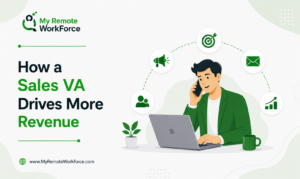
Sales Virtual Assistant: How a Sales VA Can Help Your Business Generate More Revenue
Every hour a salesperson spends updating CRM fields, researching prospects, or scheduling meetings is an hour they’re not spending in a conversation that could close. That’s not a productivity nitpick. It’s a direct, quantifiable drag on revenue, and it’s usually invisible until someone actually adds up the hours.
A Sales Virtual Assistant (Sales VA) exists to take that time back. A Sales VA handles the repetitive, time-consuming work that surrounds selling, including CRM upkeep, follow-ups, prospect research, and pipeline hygiene, remotely and at a fraction of the fully loaded cost of another sales hire.
For a growing business, that’s not just a convenience. It’s a way to add sales capacity without adding sales headcount, and headcount is usually the more expensive, slower, and harder-to-reverse decision.
The Real Cost of Letting Salespeople Do Admin Work
Here’s the math most sales leaders never run explicitly: if a quota-carrying rep costs the business $60–$100+ an hour in fully loaded compensation, and they spend 10–15 hours a week on CRM updates, scheduling, and prospect research, that’s roughly a quarter of their working time spent on tasks that don’t require a salesperson at all, work that a Sales VA can typically perform for $15–$25 an hour.
The gap between those two numbers is the case for a Sales VA. It isn’t about doing the same work more cheaply. It’s about freeing your most expensive, highest-leverage people to spend their time exclusively on the one thing only they can do: sell.
What a Sales Virtual Assistant Actually Does
A Sales VA is a remote professional who supports the activities surrounding your sales process, not the selling conversation itself. Depending on your needs, that typically includes:
Prospect research and lead generation
Lead qualification
CRM management and data entry
Email follow-ups and outreach support
Appointment scheduling
Sales pipeline updates
Contact list management
Sales reporting
Customer follow-ups
The dividing line is simple: tasks that are necessary for sales to function, but don’t require your highest-value salesperson to perform them personally.
Four Ways a Sales VA Directly Protects Revenue
1. Keeps the pipeline accurate, not just organized. An outdated CRM isn’t a cosmetic problem. Miscategorized leads, missed follow-up dates, and incomplete contact records mean real opportunities quietly fall out of the pipeline without anyone noticing until a forecast review exposes the gap. A Sales VA maintains the discipline of accurate, current CRM data that sales leadership can actually forecast against.
2. Makes follow-up a system, not a memory test. Most prospects don’t respond to the first outreach; deals are often won or lost in the third, fourth, or fifth touch. When follow-up depends on an individual rep remembering to circle back, it’s inconsistent by design. A Sales VA runs the follow-up cadence as a process, so prospects don’t disappear from the pipeline simply because someone got busy.
3. Delivers a cleaner, pre-qualified prospect list. Researching companies, identifying the right decision-makers, and gathering accurate contact data takes real time, time a rep could spend in active conversations instead. A Sales VA builds that list against your ideal customer profile, so reps start their day with prospects worth calling, not a research project.
4. Converts admin hours into selling hours, at scale. Every task moved off a rep’s plate is time reinvested directly into revenue-generating activity: more calls, more meetings, more deals actively worked. Multiplied across a full sales team, this compounds into a measurable increase in selling capacity without a single new sales hire.
When a Sales VA Is the Right Move
A Sales VA is worth evaluating when:
Your sales team is spending significant time on administrative work instead of selling
Follow-up is inconsistent and leads are going cold
CRM data is incomplete, outdated, or difficult to keep current
Prospect research is eating into active selling time
Pipeline volume is growing faster than your team’s capacity to manage it
You need more sales support without committing to another full-time hire
Outbound activity needs more consistent execution than your current team can sustain
The common thread: the work is necessary, but it doesn’t require your highest-value salesperson to do it personally.
Sales VA vs. Another Full-Time Hire
A full-time sales hire brings salary, benefits, payroll tax, recruiting cost, onboarding time, and equipment, a fixed cost commitment that doesn’t flex if the pipeline slows down. A Sales VA offers a different structure: support scoped to actual workload, adjustable as needs change, without the fixed overhead of a permanent headcount addition.
For a growing business, that flexibility often matters more than the hourly rate difference alone. It’s the difference between committing to a fixed cost based on a forecast and adding capacity that scales with what’s actually happening in the pipeline.
FAQ: Sales Virtual Assistants
What’s the difference between a Sales VA and a full sales hire? A Sales VA supports the sales process, including CRM management, follow-ups, research, and scheduling, but doesn’t own quota or run selling conversations. A full-time sales hire carries quota and closes deals; a Sales VA gives that person more time to do exactly that.
How much does a Sales VA typically cost compared to a sales rep? Sales VAs are generally engaged at $15–$25 per hour, compared to the fully loaded cost of a quota-carrying rep, which often runs $60–$100+ per hour once salary, benefits, and overhead are included.
Can a Sales VA replace a CRM administrator or sales operations hire? For many small and mid-sized teams, yes. A Sales VA can handle day-to-day CRM hygiene and pipeline updates that would otherwise require a dedicated operations hire, though larger teams with complex systems may still need dedicated ops support.
Is a Sales VA a good fit for outbound prospecting, or just admin support? Both. Sales VAs commonly support outbound activity, including prospect research, list building, and initial outreach coordination, in addition to administrative tasks, though the exact scope depends on the VA’s experience and your process.
How My Remote Workforce Can Help
At My Remote Workforce, we connect businesses with virtual assistants who support sales operations end to end, including lead research, CRM management, follow-ups, and appointment scheduling, so repetitive work comes off your team’s plate.
The goal isn’t just adding another person to the business. It’s giving your existing sales team more time to spend on the work that actually drives revenue.
Ready to put more time back into selling? Let My Remote Workforce help you find a Sales VA who can take care of the work behind your pipeline, so your team can focus on closing more business.