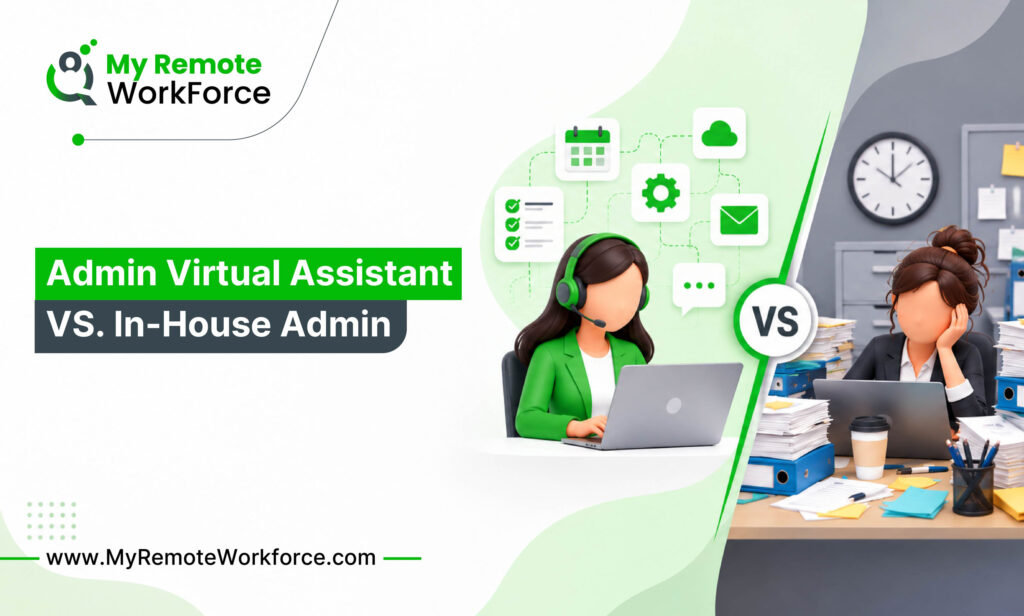
Admin Virtual Assistant vs. In-House Admin: Which Makes More Sense for a Growing Business?
As a small business grows, administrative work tends to grow with it.
Emails need to be managed. Meetings need to be scheduled. Customer information needs to be organized. Documents need to be updated. Reports need to be prepared. Follow-ups need to happen on time. Eventually, many business owners face the same question: should I hire an in-house administrative employee or work with an Admin Virtual Assistant?
There isn’t one answer that works for every business. The right option depends on factors such as workload, budget, required availability, business stage, and the type of administrative support you need. However, understanding the differences between an Admin Virtual Assistant and an in-house admin can help you determine which model makes sense for your business.
What is an Admin Virtual Assistant?
An Admin Virtual Assistant, or Admin VA, is a remote professional who provides administrative support to a business.
Depending on your requirements, an Admin VA can assist with tasks such as:
Calendar and appointment management
Email management
Data entry
Document preparation
File organization
Research
Spreadsheet updates
Meeting coordination
Administrative follow-ups
Customer and contact record management
Instead of adding another employee to your physical office, you can delegate specific administrative responsibilities to a remote professional. This can give small businesses access to administrative support while providing more flexibility around workload and staffing.
What is an In-House Administrative Employee?
An in-house admin works directly within your organization and is generally employed as part of your internal team. An in-house employee may work fixed hours, operate from your office, and handle a broad range of administrative responsibilities. This model can make sense when a company has a consistent, full-time workload and needs someone physically present or deeply integrated into daily operations. However, hiring an in-house employee also involves more than paying a salary. Businesses may need to account for recruiting, onboarding, payroll, benefits, office space, equipment, paid time off, taxes, and other employment-related expenses. That is where the comparison becomes more important for growing businesses.
Admin VA vs. In-House Admin: 6 Factors to Consider
1. Cost
Cost is often one of the first considerations for a small business. With an in-house employee, the salary is only one part of the overall cost.
Depending on the employment arrangement, businesses may also have expenses related to:
Payroll and employment taxes
Benefits
Paid leave
Recruiting
Training
Equipment
Office space
Software
Employee administration
These additional costs can make a full-time administrative hire significantly more expensive than the salary alone suggests. An Admin VA can provide a different cost structure because businesses can delegate administrative work without necessarily taking on all of the overhead associated with adding another in-house employee. For businesses that don’t need a full-time administrative workload, this distinction can be particularly important. Instead of paying for an employee’s entire working week, a company can structure support around the amount and type of work it actually needs.
2. Flexibility
Administrative workloads aren’t always consistent. You may have a particularly busy month because of a new project, increased sales activity, a product launch, or seasonal demand. At other times, the administrative workload may be lighter. An in-house employee typically has a defined schedule regardless of fluctuations in workload. A virtual assistant model can provide greater flexibility because support can be structured around the business’s needs. This can be useful for growing businesses that aren’t yet ready to commit to a full-time administrative position. You can also adjust the responsibilities of your Admin VA as your needs change. For example, a business may initially need help with scheduling and email management. As it grows, the same support may expand into data management, customer follow-ups, research, and other administrative responsibilities.
3. Hiring and Onboarding Time
Hiring an in-house employee can take time. You need to create a job description, advertise the position, review applications, interview candidates, conduct background checks where applicable, make an offer, and onboard the new employee. Then comes training. For a small business owner already dealing with a heavy workload, managing the hiring process can become another responsibility. A virtual assistant model can reduce some of the time and complexity involved in adding administrative support. At My Remote Workforce, businesses can access remote professionals for different types of support without having to build the entire hiring process from scratch. This can be particularly useful when a business needs help quickly but isn’t ready to spend months searching for the right full-time employee.
4. Workload Requirements
One of the most important questions is simple: How much administrative work do you actually have?
If you have eight hours of administrative work every day and need someone constantly available during business hours, an in-house employee may be appropriate. But what if you only have a few hours of administrative work each day? Hiring a full-time employee may mean paying for capacity that you aren’t consistently using. An Admin VA can make more sense when the workload is substantial but doesn’t justify a traditional full-time position. For example, a growing consulting company may need help managing appointments, organizing documents, updating spreadsheets, and handling administrative follow-ups for several hours a day. Instead of immediately creating a full-time position, the company can use virtual administrative support to handle the workload.
5. Access to Talent
Traditional hiring generally limits your search to candidates who are willing and able to work under the conditions your business offers. A virtual model can expand your access to remote professionals. This can be especially useful for businesses that struggle to find suitable administrative talent locally or need specific experience. Remote work also allows administrative responsibilities to be handled without requiring the person to be physically present in the same office. For many administrative tasks, the work itself doesn’t require someone to sit at a desk inside your building. If the necessary systems, communication channels, and processes are in place, administrative work can often be performed remotely.
6. Scalability
Your staffing needs can change as your business grows. You may need more support during a busy period and less support during slower periods. With an in-house employee, changing staffing levels can be more complicated. A virtual assistant model can provide greater flexibility for businesses that are still figuring out their long-term administrative needs. You can start with specific responsibilities and expand the scope of support as your business grows. This makes virtual administrative support particularly relevant for startups, entrepreneurs, and small businesses that want to grow without immediately increasing fixed overhead.
When Does an In-House Admin Make Sense?
An in-house administrative employee can be a practical option when:
Your business has a consistent full-time administrative workload.
You need someone physically present at your office.
The role requires frequent face-to-face interaction.
Administrative responsibilities are deeply integrated into your daily operations.
You have the budget and infrastructure to support a full-time employee.
For these businesses, having a dedicated internal employee can provide continuity and direct collaboration.
When Does an Admin VA Make Sense?
An Admin VA may be worth considering when:
You need administrative support but don’t need a full-time employee.
Administrative tasks are taking time away from business growth.
You want to reduce the overhead associated with traditional hiring.
Your workload changes from month to month.
You need support with specific administrative functions.
You want access to remote talent.
You need administrative help without adding another person to your physical office.
The biggest advantage is flexibility. You can focus on the work that actually requires your attention while delegating recurring administrative responsibilities to someone whose role is to handle them.
Don’t Hire for Hours You Don’t Need
One of the biggest mistakes small businesses can make is thinking they need a full-time employee simply because they need help. The better question is:
How much support does the business actually need?
If administrative work takes two or three hours a day, hiring someone for a traditional full-time position may not be the only option. A virtual assistant can allow you to match support more closely with your actual workload. This can help preserve cash flow while still giving the business the administrative capacity it needs to operate efficiently.
Admin VA vs. In-House Admin: The Bottom Line
Both hiring models have a place in business.
An in-house administrative employee can provide dedicated internal support and may be appropriate for businesses with a consistent, full-time workload. An Admin VA provides a more flexible approach that can be particularly useful for small businesses that need administrative support without the full overhead and commitment associated with traditional hiring. The decision ultimately comes down to your workload, budget, business structure, and growth plans. Before creating a full-time administrative position, take a closer look at the work that actually needs to be done. Which tasks require your attention?
Which tasks could be delegated? How many hours of administrative support do you realistically need?
Once you answer those questions, it becomes easier to determine which staffing model fits your business.
Need Administrative Support Without the Traditional Hiring Overhead?
My Remote Workforce helps businesses connect with reliable virtual assistants who can handle recurring administrative responsibilities remotely. From scheduling and email management to data entry, document organization, research, and other back-office tasks, an Admin VA can help take routine work off your plate. Ready to spend less time on administration and more time growing your business? Book a call with My Remote Workforce today to discuss your Admin VA requirements.