
Bookkeeping VAs: Tasks, Benefits & Hiring Tips
Bookkeeping VAs: Tasks, Benefits & Hiring Tips
For many growing companies, bookkeeping problems do not manifest as a single dramatic failure. They show up quietly: delayed invoices, inconsistent reconciliations, unclear cash positions, missed follow-ups, unorganized expense records, and monthly reports that arrive too late to influence decisions. At the executive level, these are not administrative inconveniences. They are operational risks. When financial data is incomplete or delayed, leadership loses visibility into cash flow, margin pressure, receivables, vendor obligations, and working capital. That makes it harder to forecast, invest, hire, price services, manage debt, or respond quickly to market changes. This is where Bookkeeping Virtual Assistants, or Bookkeeping VAs, can play a strategic role. They are not a replacement for CFOs, controllers, CPAs, or strategic finance leaders. Instead, they strengthen the finance function’s foundation by handling routine, high-volume, process-driven bookkeeping tasks consistently and with discipline.
For executives, the real question is not simply, “Can a VA do bookkeeping tasks?” The better question is: “Can a Bookkeeping VA help us create a cleaner, faster, more scalable financial operating system?”
In many cases, the answer is yes, provided the role is designed correctly.
What Is a Bookkeeping VA?
A Bookkeeping VA is a remote finance support professional who manages the day-to-day recording, organization, and maintenance of financial data. Their work typically includes transaction categorization, invoice processing, expense tracking, reconciliations, accounts payable support, accounts receivable follow-up, payroll coordination, and recurring financial reporting support. Unlike a traditional in-house bookkeeper, a Bookkeeping VA works remotely and is usually integrated into your finance operations through cloud-based accounting systems, secure communication tools, documented workflows, and scheduled reporting cadences.
The most important distinction is this: a Bookkeeping VA is not just “remote help.” When properly managed, they become part of a distributed finance function. That distinction matters for executives because distributed finance teams can give growing companies three advantages:
First, they provide scalable capacity without requiring immediate full-time hiring.
Second, they help reduce administrative overload on internal finance staff and business leaders.
Third, they create a more disciplined process for routine financial work, thereby improving reporting reliability.
A Bookkeeping VA is best suited for recurring, rules-based, data-heavy tasks. They should not be expected to replace strategic financial leadership, tax advisory, audit management, or complex financial analysis. Those responsibilities still belong with controllers, accountants, CPAs, and CFO-level professionals.
The value of a Bookkeeping VA lies in creating clean financial inputs so higher-level finance professionals can make better decisions from better data.
Why Executives Should Pay Attention to Bookkeeping Operations
Bookkeeping is often treated as a back-office task, but poor bookkeeping creates front-office consequences.
If receivables are not tracked properly, cash collection slows. If expenses are miscategorized, profitability is distorted. If reconciliations are delayed, leadership may not know the true cash position. If invoices are sent late, revenue timing suffers. If financial reports are inconsistent, strategic planning becomes guesswork.
For executives, weak bookkeeping affects five critical areas:
Cash flow visibility
Leadership needs to know how much cash is available, what is coming in, what is going out, and where short-term pressure may appear.Decision speed
Timely books allow executives to make faster decisions on hiring, vendor commitments, pricing, expansion, and investment.Operational control
Clean bookkeeping creates accountability across departments, vendors, clients, and internal teams.Compliance readiness
Organized records reduce stress during tax preparation, audits, funding reviews, or due diligence.Scalability
As transaction volume grows, undocumented bookkeeping processes become a bottleneck. A structured VA-supported model helps the finance function scale without breaking.
This is why the role should not be viewed only through a cost-saving lens. Cost efficiency matters, but the deeper value is operational maturity.
What Bookkeeping VAs Actually Do
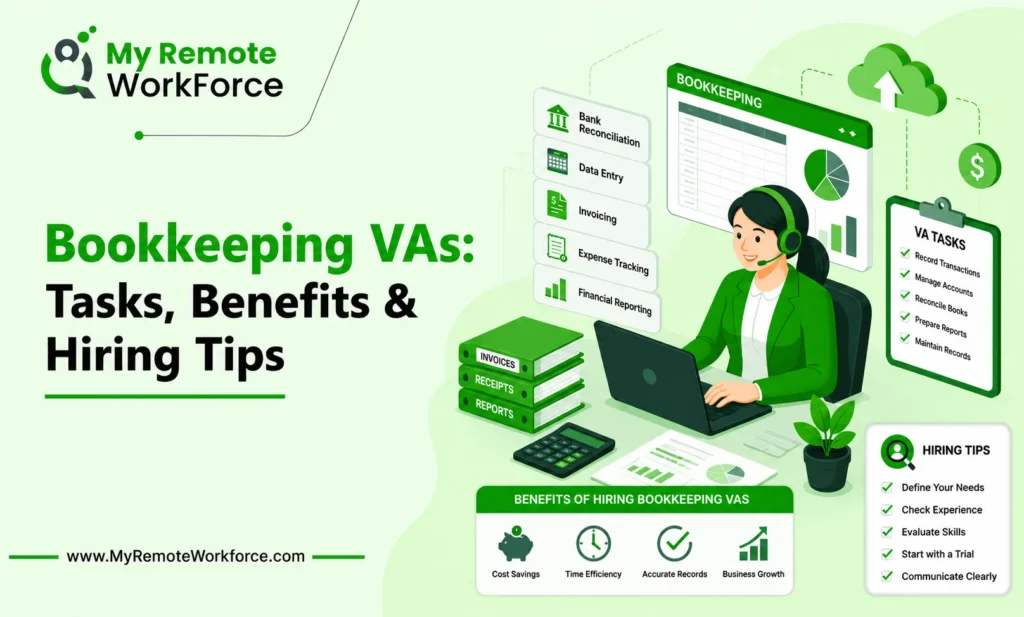
A Bookkeeping VA can support a wide range of routine financial operations. The exact scope depends on the company’s size, industry, software stack, internal finance team, and reporting needs. Common responsibilities include:
Accounts payable support
A Bookkeeping VA can help manage vendor bills, organize payment schedules, track due dates, verify supporting documents, and maintain vendor records. This reduces the risk of missed payments, duplicate payments, and strained vendor relationships.Accounts receivable support
They can prepare invoices, track outstanding payments, update aging reports, send follow-up reminders, and help leadership monitor collection timelines. This is especially valuable for businesses where delayed collections affect working capital.Bank and credit card reconciliations
Regular reconciliations help confirm that accounting records match bank activity. This is one of the most important controls in any finance function because it helps detect errors, omissions, and irregularities early.Expense categorization
Accurate categorization allows leadership to understand where money is going. Without consistent expense coding, financial reports become unreliable and margin analysis becomes difficult.Payroll coordination support
A Bookkeeping VA may assist with payroll data preparation, timesheet coordination, payroll system updates, or recordkeeping. Final payroll approval should remain with authorized internal personnel or qualified payroll providers.Monthly reporting support
They can help prepare recurring reports such as profit and loss statements, balance sheet summaries, cash flow reports, accounts receivable aging, accounts payable aging, and expense summaries.Software and data management
Bookkeeping VAs often work inside tools such as QuickBooks, Xero, FreshBooks, Zoho Books, Wave, Sage, Microsoft Excel, and Google Sheets. Their ability to maintain clean records across these platforms is central to their effectiveness.
The goal is not simply to “complete tasks.” The goal is to maintain a reliable financial rhythm.
The Executive Case for Hiring a Bookkeeping VA
Hiring a Bookkeeping VA is often framed in terms of cost savings, but that is only part of the business case. The stronger executive case includes cost, control, speed, visibility, and scalability.
1. Lower operating cost without sacrificing structure
A Bookkeeping VA can provide flexible capacity without the full cost of a traditional in-house role. This is especially useful for small and mid-sized businesses that need consistent bookkeeping support but may not yet require a full-time employee. However, executives should avoid making cost the only decision factor. The cheapest option can become expensive if it creates errors, missed deadlines, weak controls, or rework for accountants.
The right goal is not the lowest-cost bookkeeping support. The goal is cost-effective financial reliability.
2. Faster and more reliable reporting
Executives need timely numbers. If reporting arrives weeks after the month closes, the information may already be stale. A Bookkeeping VA can help accelerate the monthly close by ensuring transactions are updated, reconciliations are completed, invoices are tracked, and supporting documentation is organized throughout the month.
This gives leadership faster access to decision-grade financial information.
3. Better cash flow discipline
Cash flow visibility depends on consistent bookkeeping. When receivables, payables, expenses, and bank balances are not updated regularly, leadership cannot confidently plan. A Bookkeeping VA can help maintain the daily and weekly financial hygiene required for stronger cash flow management.
For businesses with tight margins, seasonal revenue, project-based billing, or rapid growth, this visibility can be especially valuable.
4. Reduced burden on leadership and internal teams
In many growing companies, bookkeeping tasks fall on founders, office managers, operations teams, or already-stretched finance staff. This creates a distraction and increases the risk of errors. Delegating structured bookkeeping work to a trained VA gives leadership more time to focus on sales, operations, client delivery, hiring, and growth strategy.
5. Scalable support during growth
As companies grow, transaction volume increases. More customers, vendors, employees, contractors, subscriptions, reimbursements, and invoices create more bookkeeping complexity. A Bookkeeping VA provides companies with a flexible way to increase financial capacity without waiting until the function is overwhelmed.
Signs Your Business May Need a Bookkeeping VA
A Bookkeeping VA may be a strong fit if your company is experiencing any of the following issues:
Your books are consistently behind schedule.
Invoices are not being sent or followed up on quickly enough.
Bank and credit card reconciliations are delayed.
Leadership lacks a clear view of cash flow.
Expense categories are inconsistent.
Your accountant spends too much time cleaning up records.
You are preparing reports manually every month.
Financial data lives across too many spreadsheets.
Internal staff are spending too much time on routine finance administration.
Growth is increasing transaction volume faster than your current team can manage.
These signs usually point to a process-capacity gap. The company does not necessarily need more strategic finance leadership yet. It may first need cleaner execution at the bookkeeping layer.
How to Hire a Bookkeeping VA the Right Way
Hiring a Bookkeeping VA should be treated as an operating decision, not a quick outsourcing experiment. The quality of the outcome depends heavily on how the role is scoped, onboarded, measured, and governed.
1. Define the scope before hiring
Start by identifying exactly what you want the VA to handle. Separate tasks into categories such as invoicing, expense entry, reconciliations, reporting support, payroll coordination, vendor management, and software updates.
Also, define what the VA should not handle. For example, they may prepare reports, but leadership or an accountant should review and approve them. They may organize payroll data, but they should not have unchecked authority over payroll disbursement. They may support tax preparation, but they should not provide tax advice unless properly qualified.
Clear boundaries protect the business.
2. Match experience to your business model
A Bookkeeping VA who has worked with eCommerce companies may understand payment gateways, refunds, inventory-related transactions, and sales tax documentation. A VA with professional services experience may be stronger in invoicing, retainers, contractor payments, project-based billing, and receivables tracking.
Industry familiarity matters because bookkeeping workflows vary by business model.
Executives should look for candidates who understand the company’s transaction patterns, not just general bookkeeping.
3. Test software fluency
The VA should be comfortable with your accounting tools and related systems. Common platforms include QuickBooks, Xero, FreshBooks, Zoho Books, Wave, Sage, Excel, and Google Sheets.
A practical test is often more useful than a general interview. For example, ask candidates how they would categorize sample transactions, reconcile a bank statement, identify missing documentation, or prepare an accounts receivable aging summary.
The goal is to confirm accuracy, judgment, and comfort with real workflows.
4. Build a controlled onboarding process
A strong onboarding process should include:
A documented task list.
Access rules and permissions.
Reporting deadlines.
Communication channels.
Escalation procedures.
File naming conventions.
Approval workflows.
Security expectations.
Quality review checkpoints.
Without this structure, even a skilled VA may struggle because the operating environment is unclear.
5. Set performance metrics
Executives should define success in measurable terms. Useful KPIs may include:
Monthly close timeline.
Reconciliation completion rate.
Invoice processing turnaround time.
Accounts receivable follow-up cadence.
Error rate in transaction categorization.
Percentage of transactions with complete documentation.
Timeliness of weekly or monthly reports.
These metrics help move the role from “task support” to accountable finance operations.
Key Takeaways for Executives
A Bookkeeping VA is not just an administrative resource. When properly integrated, they can strengthen the operational foundation of the finance function.
They are best suited for routine, recurring, process-driven bookkeeping tasks.
Their value increases when they are supported by clear workflows, secure systems, defined KPIs, and internal oversight.
They should not replace strategic finance leadership, tax advisory, or CPA-level review.
The strongest business case is not only cost savings. It is better visibility, faster reporting, cleaner data, improved control, and scalable capacity.
Conclusion
For growing companies, financial discipline is not optional. It directly affects cash flow, decision-making, compliance, and scalability. A Bookkeeping VA can help bring structure to the routine financial work that keeps the business running. By managing recurring bookkeeping tasks, maintaining clean records, supporting reconciliations, and improving reporting cadence, they provide executives with more reliable visibility into the company’s financial health.
The key is to hire with intention. Define the scope, protect financial data, document workflows, measure performance, and keep strategic oversight inside the business. When implemented correctly, a Bookkeeping VA is not just a lower-cost staffing option. It is a practical way to build a more resilient and scalable finance operation. To learn how My Remote Workforce can help you build reliable remote bookkeeping support for your business, visit www.myremoteworkforce.com.